
SEO Audit & Website
Optimization for DUX Agency
PROJECT OVERVIEW
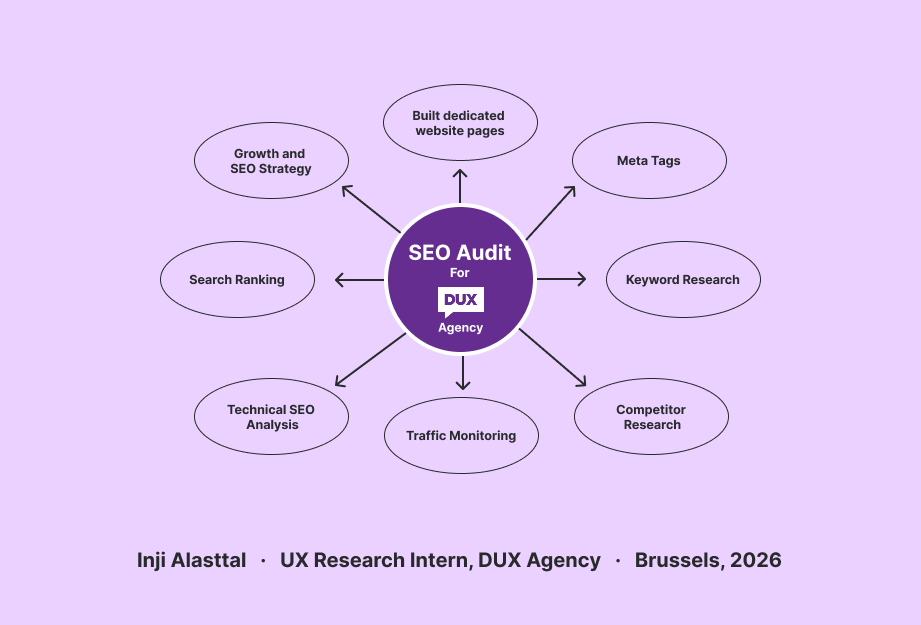
During my UX/UI Design internship at DUX Agency, a Brussels-based UX Research agency, I conducted and delivered a 44-pages strategic SEO audit to evaluate the website’s visibility, technical performance, and overall search engine readiness.
Although DUX had an established reputation and already worked with important clients through referrals and professional networks, the website was not being fully leveraged as a lead-generation channel. The objective was to identify opportunities that could improve organic visibility and better showcase the agency’s expertise online. Here are some of the key findings and improvements that were implemented
MY ROLE: SEO Audit • Research • Website Optimization • Content Structure • Service Page Creation.
The Challenge
The website presented DUX’s expertise effectively, but several SEO opportunities were limiting its discoverability.
Key findings included:
- Missing SEO metadata on several pages.
- Weak heading hierarchy and page structure.
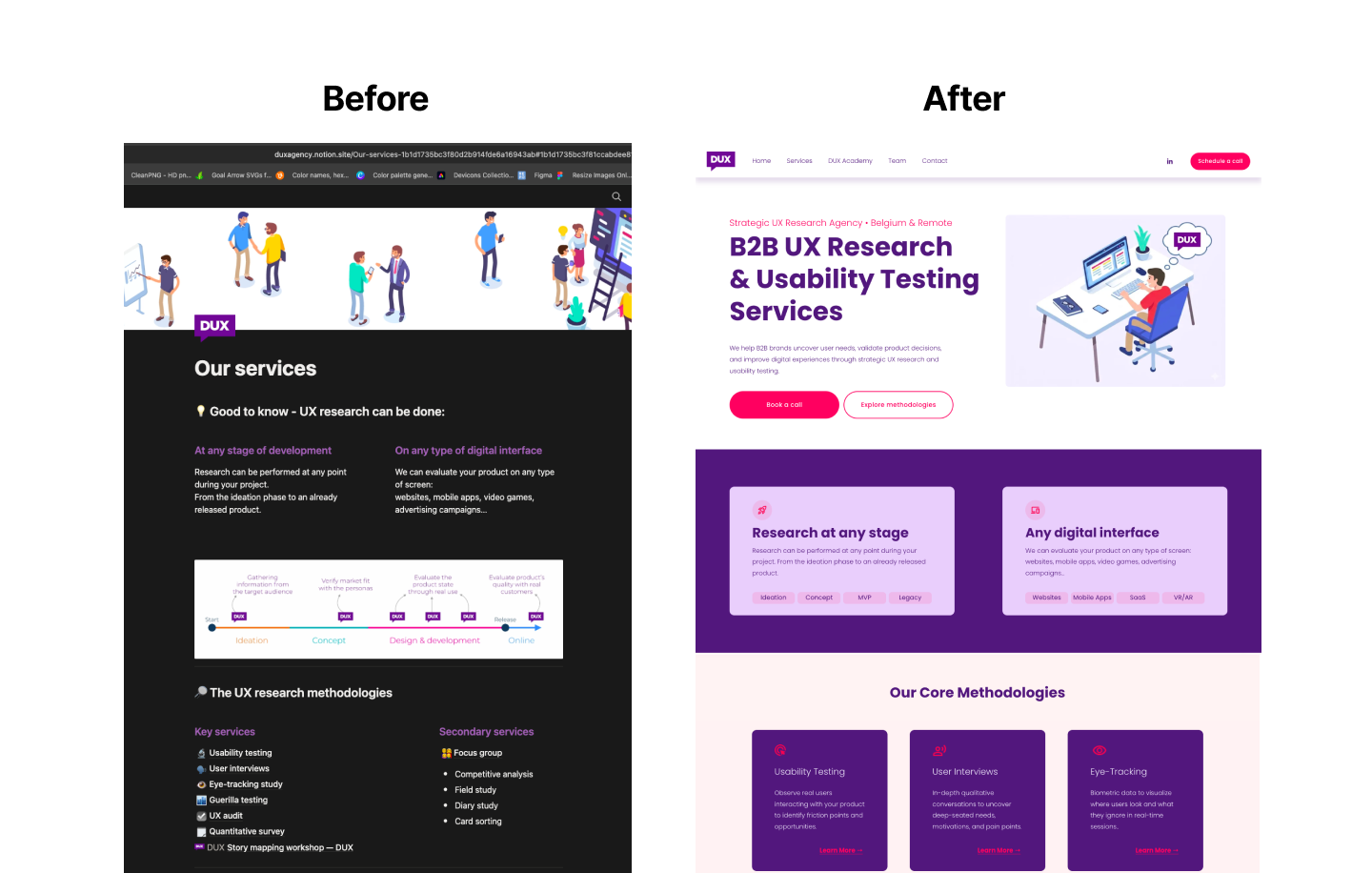
- Service offerings hosted externally on Notion rather than on the website itself.
- Limited keyword targeting.
- Missing image alt text.
- Slow mobile performance.
- Lack of content supporting different search intents.
As a result, search engines had limited information to understand and rank the website for relevant UX Research and Usability Testing queries.
Full SEO Audit
I conducted a structured audit across 6 dimensions:
Technical SEO, Competitor Analysis, Search Intent Analysis, Keyword Strategy, Local SEO, and Brand Visibility.
Each finding was documented with severity level, business impact, and specific recommendation.
The audit revealed that while competitors were investing in dedicated service pages, case studies, and educational content, DUX’s website functioned more as a portfolio than an SEO-driven acquisition channel.
Service Page Migration (Most Critical Fix)
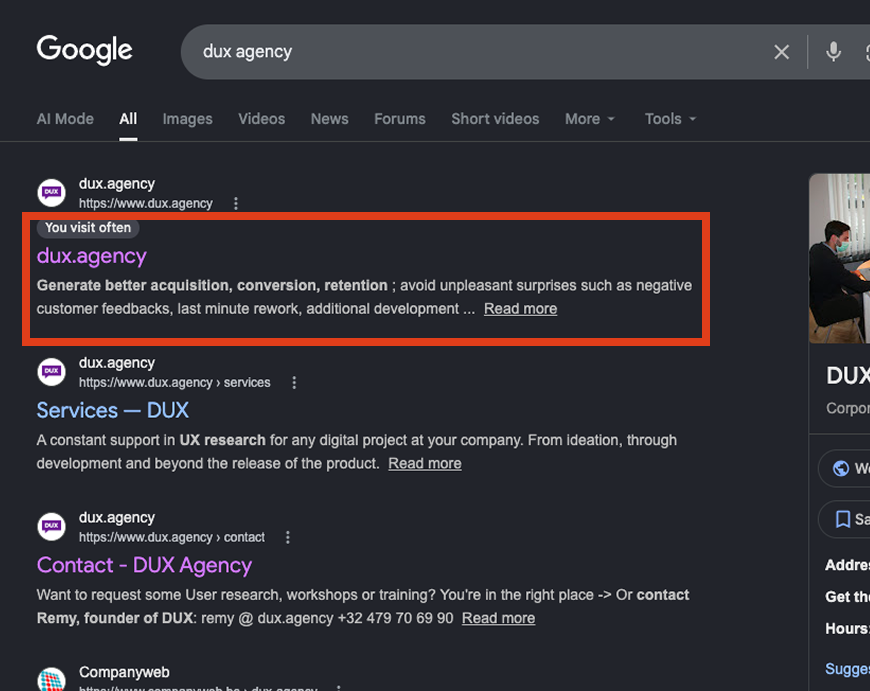
The most significant structural problem was that DUX’s core service offerings were hosted on an external Notion page, completely invisible to search engines. I designed and built dedicated service pages directly on the Squarespace website, live and fully responsive on mobile.
This created a stronger site structure, improved content ownership, and provided search engines with indexable service-related content.
Why this matters ?
Moving service content from Notion to the website means Google can now index DUX’s expertise. For keywords like ‘usability testing Belgium’ , this alone creates first-page ranking potential where none existed before.
SEO Foundations
I optimized elements that were accessible through the CMS, including:
SEO page titles
Meta descriptions
Heading structure
Image alt text
Internal linking opportunities

Technical Fixes Implemented
- Optimized SEO page titles and meta descriptions for all core pages, replacing auto-generated content with keyword-targeted messaging.
- Added descriptive, keyword-relevant alt text to images across the site
- Identified and flagged inactive Weglot script causing console errors and page slowdown
- Documented heading hierarchy issues on Academy and Team pages with specific H1/H2/H3 recommendations
- Flagged missing cookie consent banner, GDPR compliance issue for a Belgian agency
Key points
This project taught me that SEO and UX are not separate disciplines — they are two dimensions of the same problem: helping the right people find the right information at the right moment. A slow mobile site, an unclear heading structure, or service content buried in Notion are all user experience problems before they are SEO problems.
What This Demonstrates
The combination of UX thinking, SEO strategy, competitor analysis, and hands-on implementation in a real agency context for a client base that includes major Belgian institutions and European organizations.